| Property | Value |
|---|---|
| Peptide Sequence | pGlu-Glu-Gln-Leu-Glu-Arg-Ala-Leu-Asn-Ser-Ser |
| Molecular Formula | C51H84N16O21 |
| Molecular Weight | 1257.3 g/mol |
| CAS Number | 1208243-50-8 |
| PubChem CID | 91810664 |
| Synonyms | Cibinetide, 1208243-50-8, ARA290, PHBSP, ARA 290 |
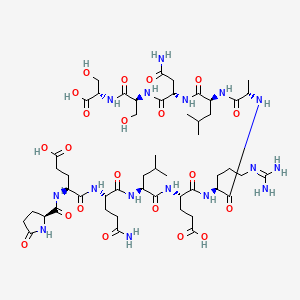 Source PubChem
 ARA-290 is a novel peptide derived from erythropoietin (EPO) that has emerged as a promising therapeutic candidate across multiple disease areas. Unlike its parent molecule EPO, ARA-290 selectively activates tissue repair mechanisms without stimulating erythropoiesis, offering a potentially safer therapeutic profile. This synthetic peptide mimics EPO’s tissue-protective properties by specifically binding to the innate repair receptor (IRR), a distinct receptor complex that mediates cytoprotective and anti-inflammatory effects.
Initial preclinical and clinical studies have demonstrated ARA-290’s broad therapeutic potential, particularly in conditions characterized by inflammation, tissue damage, and neuropathy. Its unique mechanism of action involves modulating immune responses, promoting tissue repair, and protecting neural tissue, making it particularly relevant for diseases ranging from neurodegenerative conditions to metabolic disorders.
ARA-290 has been investigated for its potential in Alzheimer’s disease (AD) therapy. It was found to decelerate the progression of AD-like pathology in early-onset models by modulating monocyte functions, specifically increasing the ratio of patrolling monocytes that help clear amyloid-β from the brain.1
ARA-290 has been evaluated in patients with type 2 diabetes, where it improved metabolic control and neuropathic symptoms. It was shown to enhance hemoglobin A1c levels and lipid profiles, as well as increase corneal nerve fiber density, indicating its potential in managing diabetes-related complications.2
In patients with sarcoidosis-associated small fiber neuropathy, ARA-290 has been effective in reducing neuropathic pain and improving quality of life. It increased corneal nerve fiber density and improved sensory pain thresholds, suggesting its role as a disease-modifying agent.3
ARA-290 also exhibits analgesic properties by targeting the TRPV1 channel, which is involved in pain sensation. This mechanism highlights its potential as a novel pain treatment option, integrating immune modulation with nociception.4
In experimental autoimmune neuritis, ARA-290 has shown efficacy in suppressing inflammation and promoting nerve regeneration without inducing hematopoiesis, making it a candidate for treating autoimmune neuropathies.5
ARA-290 has been studied for its tissue-protective effects in critical limb ischemia, where it improved functional and histological outcomes in ischemic conditions, supporting its development as a therapeutic adjunct for ischemic injuries.6
Lorem ipsum dolor sit amet, consectetur adipiscing elit. Ut id sapien ultricies, varius augue eu, tincidunt urna. Donec nec nisl consectetur, sagittis leo quis, dignissim lacus. Suspendisse maximus, lorem at porttitor lacinia, tortor ante aliquam purus, molestie lacinia dolor nibh ut ex. Quisque id rutrum tortor. Duis a ornare leo, at consequat leo. Morbi non ornare nisi. Nam eu accumsan sem, ut posuere augue. Morbi lacinia nulla metus, quis cursus velit lacinia vel. Vestibulum tristique et purus eget lobortis. Morbi hendrerit eu turpis nec maximus. Sed et scelerisque nibh, non scelerisque nibh. Nullam quis iaculis libero. Etiam quis dui varius, blandit metus at, convallis nisl. Cras dictum est vitae dui lacinia, vitae pharetra ante finibus. In sollicitudin risus nec turpis sollicitudin, in commodo ex viverra.
| Property | Value |
|---|---|
| Peptide Sequence | pGlu-Glu-Gln-Leu-Glu-Arg-Ala-Leu-Asn-Ser-Ser |
| Molecular Formula | C51H84N16O21 |
| Molecular Weight | 1257.3 g/mol |
| CAS Number | 1208243-50-8 |
| PubChem CID | 91810664 |
| Synonyms | Cibinetide, 1208243-50-8, ARA290, PHBSP, ARA 290 |
Source PubChem ARA-290 is a novel peptide derived from erythropoietin (EPO) that has emerged as a promising therapeutic candidate across multiple disease areas. Unlike its parent molecule EPO, ARA-290 selectively activates tissue repair mechanisms without stimulating erythropoiesis, offering a potentially safer therapeutic profile. This synthetic peptide mimics EPO’s tissue-protective properties by specifically binding to the innate repair receptor (IRR), a distinct receptor complex that mediates cytoprotective and anti-inflammatory effects.
Initial preclinical and clinical studies have demonstrated ARA-290’s broad therapeutic potential, particularly in conditions characterized by inflammation, tissue damage, and neuropathy. Its unique mechanism of action involves modulating immune responses, promoting tissue repair, and protecting neural tissue, making it particularly relevant for diseases ranging from neurodegenerative conditions to metabolic disorders.
ARA-290 has been investigated for its potential in Alzheimer’s disease (AD) therapy. It was found to decelerate the progression of AD-like pathology in early-onset models by modulating monocyte functions, specifically increasing the ratio of patrolling monocytes that help clear amyloid-β from the brain.1
ARA-290 has been evaluated in patients with type 2 diabetes, where it improved metabolic control and neuropathic symptoms. It was shown to enhance hemoglobin A1c levels and lipid profiles, as well as increase corneal nerve fiber density, indicating its potential in managing diabetes-related complications.2
In patients with sarcoidosis-associated small fiber neuropathy, ARA-290 has been effective in reducing neuropathic pain and improving quality of life. It increased corneal nerve fiber density and improved sensory pain thresholds, suggesting its role as a disease-modifying agent.3
ARA-290 also exhibits analgesic properties by targeting the TRPV1 channel, which is involved in pain sensation. This mechanism highlights its potential as a novel pain treatment option, integrating immune modulation with nociception.4
In experimental autoimmune neuritis, ARA-290 has shown efficacy in suppressing inflammation and promoting nerve regeneration without inducing hematopoiesis, making it a candidate for treating autoimmune neuropathies.5
ARA-290 has been studied for its tissue-protective effects in critical limb ischemia, where it improved functional and histological outcomes in ischemic conditions, supporting its development as a therapeutic adjunct for ischemic injuries.6
Lorem ipsum dolor sit amet, consectetur adipiscing elit. Ut id sapien ultricies, varius augue eu, tincidunt urna. Donec nec nisl consectetur, sagittis leo quis, dignissim lacus. Suspendisse maximus, lorem at porttitor lacinia, tortor ante aliquam purus, molestie lacinia dolor nibh ut ex. Quisque id rutrum tortor. Duis a ornare leo, at consequat leo. Morbi non ornare nisi. Nam eu accumsan sem, ut posuere augue. Morbi lacinia nulla metus, quis cursus velit lacinia vel. Vestibulum tristique et purus eget lobortis. Morbi hendrerit eu turpis nec maximus. Sed et scelerisque nibh, non scelerisque nibh. Nullam quis iaculis libero. Etiam quis dui varius, blandit metus at, convallis nisl. Cras dictum est vitae dui lacinia, vitae pharetra ante finibus. In sollicitudin risus nec turpis sollicitudin, in commodo ex viverra.